Read More
Stagflation has become the top worry of late, but the exact nature of the problem it poses remains unclear.
ADVERTISEMENT
SCROLL TO CONTINUE WITH CONTENT
Most people would reference the classic example of the 1970s, when both inflation and unemployment rates were high.
There is a simple market indicator called the misery index, which simply adds up these two rates. High levels for one of these will be painful; so if readings for both are high, it will be, in a nutshell, miserable.
These two are the orthogonal dimensions in charting the Phillips curve, which prescribes a negative relationship between them. However, stagflation essentially refers to the breakdown of such trade-offs. Instead, the Phillips curve (if it is still downward sloping) shifts outward.
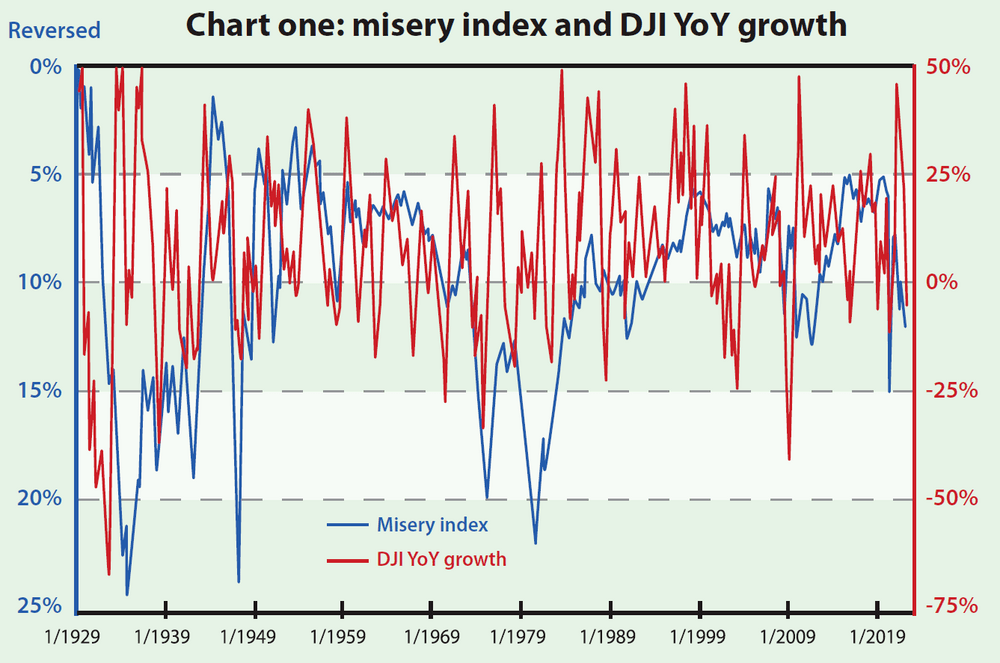
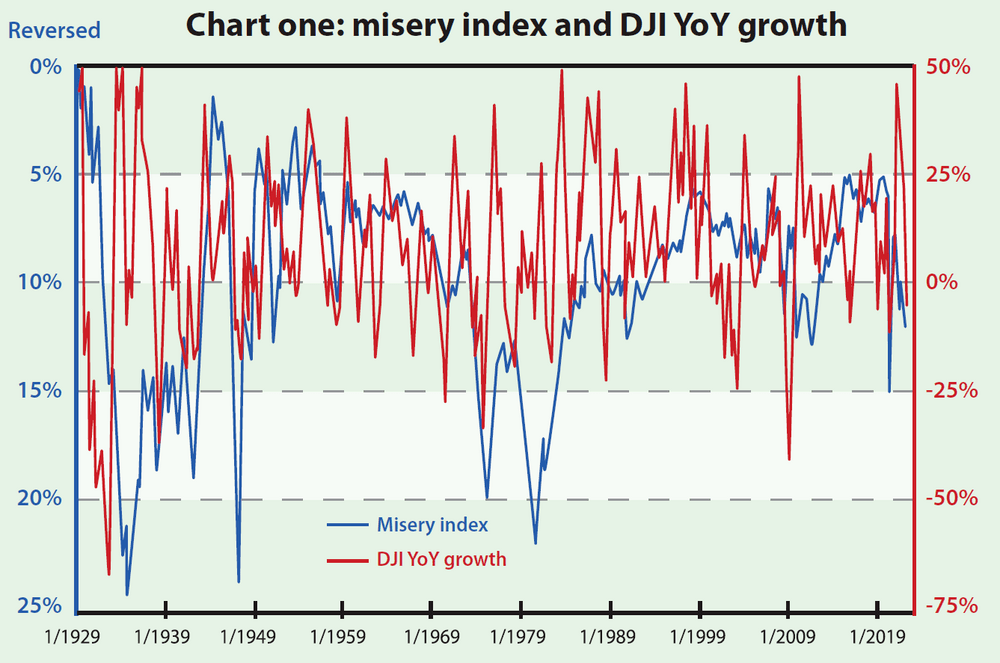
Stock index growth should be low when the misery index is high. From chart one, they are indeed inversely related to each other (left axis reversed) except the latter being more volatile.
Loosely speaking, if the two add up to over 10 percent, the Dow Jones Index should see a year-over-year contraction.
The latest additions for the two amount to around 12 percent while the DJI has turned out to be down by around 5 percent.
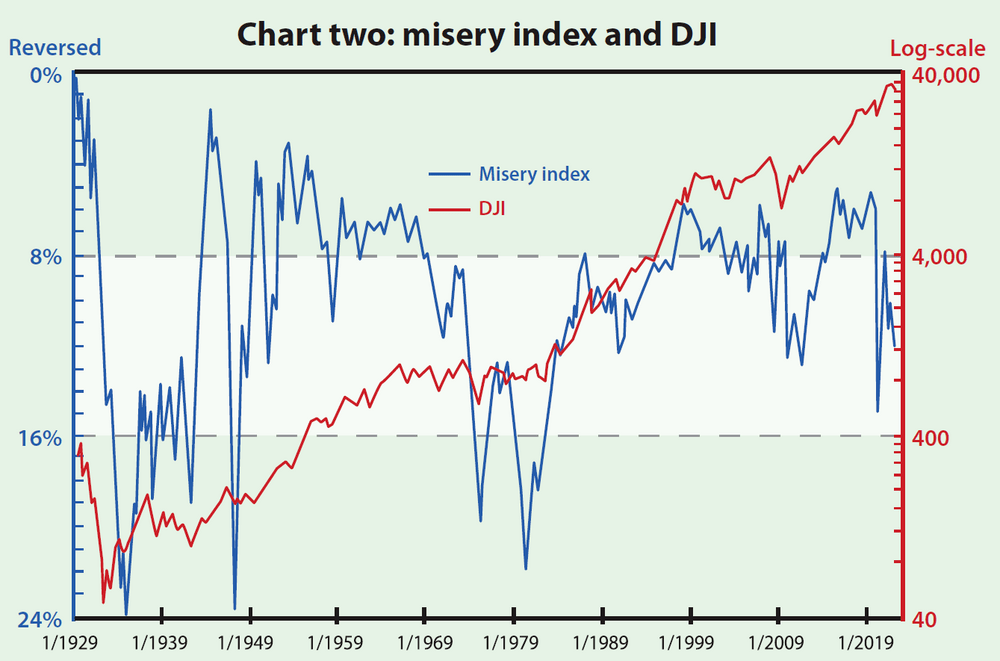
In terms of DJI levels, as chart two shows, whenever the misery index is higher than say 10 percent, the DJI exhibits a flat trend for a decade or two. There is a jargon for this - a "secular bear market."
One classic example is the post-Great Depression '30s, when inflation was low (actually very severe deflation at minus 10 percent) but the unemployment rate was very high (the worst month saw 25 percent).
Another is 1970s stagflation, when both rates were high but magnitudes were relatively contained compared with the 1930s.
In both cases, the ensuing secular bear market lasted for about 15 years.
Will now begin another 15 years of a secular bear market?
Let's see if inflation can come down meaningfully next year without pushing up the unemployment rate substantially.
Law Ka-chung has worked in the financial industry and the government for two decades. Reach him at mewe.com/join/lawkachung, facebook.com/kc.economist, lawkachung@gmail.com