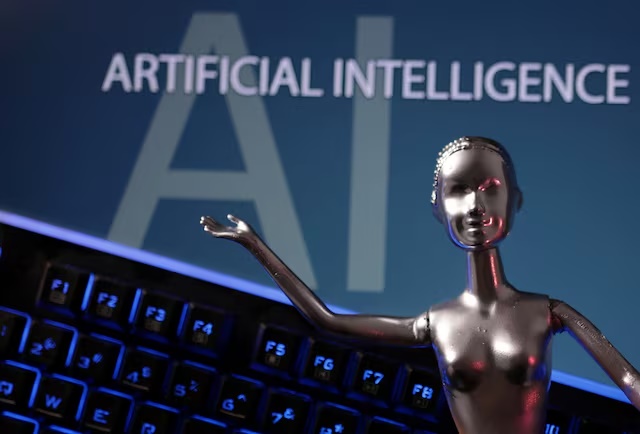
What will it look like when AI comes for your job? How will it happen? Will it happen at all? These are the questions on so many minds in the age of OpenAI and Google's Bard, of the suddenly ubiquitous text and image generators such as ChatGPT and Midjourney.
The maddening thing is that, at least at first, it's probably not going to look like much of anything. There will be no cybernetic android that lumbers over to your desk and takes over your work duties, no disembodied robot voice that suddenly assumes command over your department.
It might just look like routine layoffs, or a freelancer having more trouble finding work.
A friend of mine, a veteran artist and prolific freelance illustrator, told me it's been a "really weak year," and believes the rise of AI image generation is to blame. Art directors at ad agencies, where he's made much of his past income, told him they've begun using Midjourney internally; the work isn't published publicly, so there are fewer concerns about copyright.
That is what it will look like to many as managers turn to AI to cut costs: not a robot apocalypse, but a slowly declining rate of work on offer. Maddeningly, few are likely to agree on what constitutes technological replacement, and what does not.
Case in point: since the text generators burst onto the scene late last year, a number of digital media companies have been experimenting with AI-generated content. CNET quietly started publishing AI-written stories in November, and BuzzFeed and Insider have announced that they're trying out different forms of AI-generated content too.
All three companies have also been experimenting with laying off their staff. CNET fired 10 percent of its newsroom in March, and Insider followed suit in April. BuzzFeed shut down its entire Pulitzer Prize-winning news division, home to around 60 journalists, and laid off 15 percent of employees companywide.
Now, digital media are a particularly punishing business - another former heavyweight, Vice, declared bankruptcy this month - and one that's no stranger to layoffs at any given time.
Yet the timing struck many as alarming, especially at a moment when executives in other industries are explicitly stating their intent to use AI to take over jobs previously done by humans; IBM chief executive Arvind Krishna, for instance, estimated AI would replace around 8,000 of the firm's jobs in coming years.
Not two weeks after the news division was shut down, BuzzFeed held its annual Investor Day, at which chief executive Jonah Peretti spoke about, among other things, the ways his company was embracing AI. "BuzzFeed has always lived at the intersection of technology and creativity," he said at the event. "And recent developments in artificial intelligence represent an opportunity to take this convergence to the next level."
BuzzFeed, he continued, is using generative AI to "establish the blueprint for AI-driven revenue growth across the company And with the developments with both creators and AI, we see the opportunity to build a content creation model that makes our creative team more efficient and sustainably expands our output without increasing fixed costs."
When I shared the observation that BuzzFeed seemed to be going all in on AI on the heels of laying off its news staff on Twitter, the reaction was, uh, strong. "Unrelentingly bleak," MSNBC host Chris Hayes commented. "None of this has to happen," writer Molly Jong-Fast tweeted. "Writing doesn't need to be automated."
Peretti sent me a direct message accusing me of "completely misrepresenting" what he said. But what started as a hostile exchange - "totally irresponsible," he called my gloss on his speech - soon became something more productive, as he explained his views on how BuzzFeed would be utilizing AI.
Our conversation via DM offered a window into the thinking of an executive in a field that generative AI stands to affect.
"In the future, AI will replace static content because content will become more personalized and dynamic," he said. "For example, you'll be able to 'chat with an article' to get related information or background on a story you might have missed earlier. This has nothing to do with replacing writers or having AI write articles."
I pointed out that laying off the people whose jobs were to write articles, and the company's embrace of AI, is nonetheless to make the case to investors that said new technology will make up the difference.
"What happened to News and AI are unrelated," he said, "I shut down BuzzFeed News because it was losing millions of dollars."
He went on: "Some investors might think it is about 'automated output' as you say. I've never said that, and I think it is a big misunderstanding of how AI will ultimately be used in media. Think of AI as a new medium, not as a labor replacement. We won't be replacing BFN output; we'll be making totally different types of content. We'll need creative people to make these new formats."
And herein lies the crux of the matter. I believe Peretti when he says he's not looking at this as a way to replace workers - even if I am absolutely convinced that he's trying to replace their value.
But when automation unfolds, it's rarely a one-to-one affair. It's not as though there's going to be a staff writer one day, and a bot that is trained to reproduce her output that will be deployed the next. In the world of news-gathering, anyway - workers like voice-over artists and illustrators have found their art vacuumed up and spat out by generative AI trained on their work.
Automation is uneven and messy, and it's far more likely to proceed the way we're seeing unfold at BuzzFeed - previously there was a big expensive team of humans doing difficult and labor-intensive work, and now they are gone and there is a different content product altogether, one built by a combination of new technology and input from a more precarious worker.
When I asked if he would try to maintain the same output without the news desk, he didn't answer, and that certainly appears to be the plan.
The way he sees it, I think, is that BuzzFeed News was simply no longer viable. Shuttering that department was one decision; embracing AI for a different part of his business was another.
But it's hard to say whether Peretti would have been comfortable jettisoning BuzzFeed News if there wasn't a buzzy technology to create new kinds of content to intrigue investors with.
That's speculative, and Peretti insists otherwise.
But AI is above all an ambiguity generator. It allows those who hold the power to justify making all kinds of calls, in the name of embracing the future, improving efficiency and so on. And in this still very young AI-infested moment of ours, we can't be sure which way many of those calls will break.
There are, however, plenty of worrying signs -studio executives refused to agree not to use AI that would displace writers, for one - and ample anecdata in the form of all those Twitter threads about workers getting the boot in favor of ChatGPT.
But it's still hard to know how, when and if AI will have a major impact on the jobs picture.
In the end, we're still getting more AI and fewer humans - even if the AI is not doing the humans' job, exactly. AI will be used by executives and managers much this way, I think: to help gin up investment in products that require less labor costs to make, to buffer layoffs or attrition in human departments, and to hire more part-time or project-based workers.
There's no jobs apocalypse coming; there's just a series of managers making the calls they think will best benefit their bottom line, and serve their boards. Just like they're supposed to - AI or no.
Los Angeles Times (TNS)