Read More
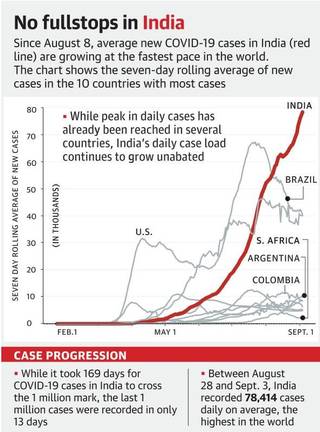
Even as testing in India has increased to over a million a day, a growing reliance on screening for antigens or viral proteins is creating more problems.
ADVERTISEMENT
SCROLL TO CONTINUE WITH CONTENT
These tests are cheaper and yield faster results but are not as accurate. The danger is that the tests may falsely clear many who are infected with the coronavirus.
In Uttar Pradesh, India’s most populous state with a limited health care system, the situation is already grim. With a total 253,175 patients and 3,762 deaths, the heartland state is staring at an inevitable surge and with the shortage of hospital beds and other health infrastructure.
Sujata Prakash, a nurse in the state capital Lucknow, has recently tested positive for the coronavirus. But the hospital ward where she worked diligently refused her admission because there was no empty bed. She waited for over 24 hours outside the surgical ward, sitting on patients’ chairs, before she was allotted one.
“The government can shower flower petals on the hospitals in the name of corona warriors, but can’t the administration provide a bed when the same warrior needs one,” said Prakash’s husband, Vivek Kumar.
Others haven’t been so lucky.
When journalist Amrit Mohan Dubey fell sick this week, his friends called the local administration for an ambulance. It arrived two hours late and by the time Dubey was taken to the hospital, he died.
“Had the ambulance reached in time, we could have saved Amrit,” said Zafar Irshad, a colleague of the journalist.
In rural Maharashtra, the worst-affected state with 863,062 cases and 25,964 deaths, doctors said measures like wearing masks and washing hands had now largely been abandoned.
“There is a behavioral fatigue now setting in,” said Dr. S.P. Kalantri, the director of a hospital in the village of Sevagram.
He said that the past few weeks had driven home the point that the virus had moved from India’s cities to its villages.
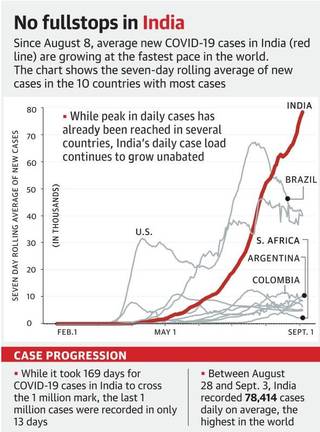
“The worst is yet to come,” said Kalantri. “There is no light at the end of the tunnel.”-AP Graphic: The Hindu