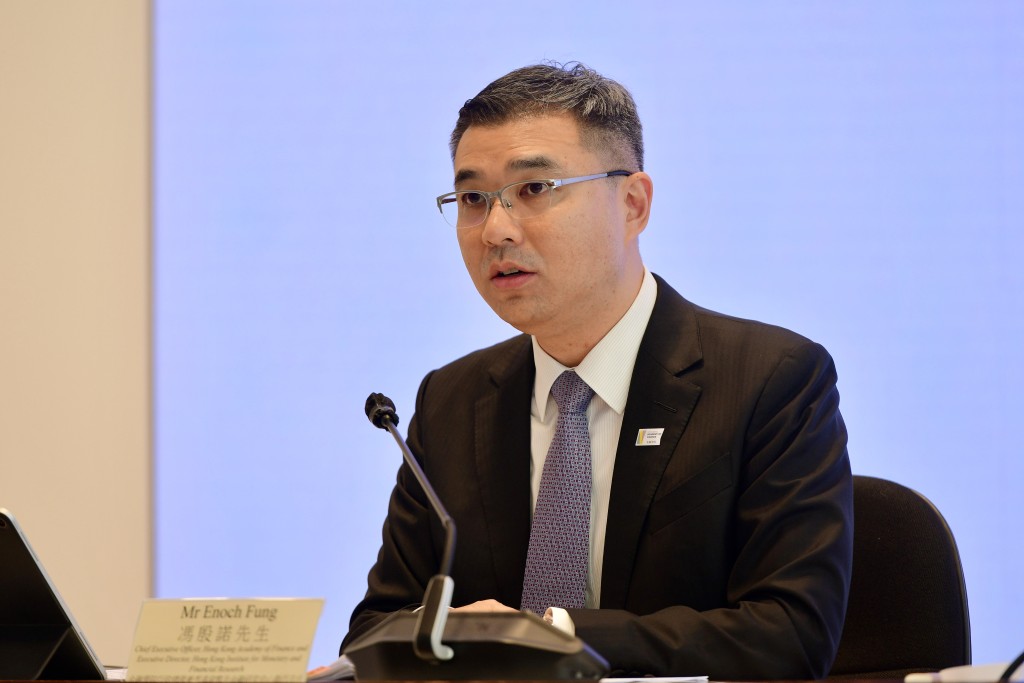
Developing countries are concerned about the long-term economic impact of climate change, prompting them to seek green transformation amid recent volatility in energy prices, said Enoch Fung Yan-lok, chief executive of the Hong Kong Academy of Finance and executive director of the Hong Kong Institute for Monetary and Financial Research.
Fung pointed out that developing countries also face a substantial funding gap in accelerating the diversification of energy supply and expanding renewable energy infrastructure.
A report released by the HKIMR, the research arm of the AoF, shows that transition finance has gained clear momentum, with 60 percent of surveyed financial institutions and stakeholders indicating they are already participating in or exploring transition finance. The Asia-Pacific region shows higher levels of engagement, while North America remains relatively cautious.
The survey, conducted in collaboration with the CFA Institute from December last year to January this year, interviewed 1,050 global market participants, including financial institutions such as banks and insurance companies, as well as other key stakeholders.
Seventy-four percent of surveyed institutions expect the global transition finance market to remain stable or grow over the next three years, with Asia-Pacific institutions the most optimistic at 91 percent. The report puts forward several recommendations, including maintaining high regulatory and policy clarity and deepening regional cooperation, to promote the establishment of a thriving transition finance ecosystem in Hong Kong.
Fung said financial institutions are primarily concerned with whether risk-return profiles are attractive, whether definitions of green projects are clear, and whether the actual environmental impact can be measured. The industry is promoting product innovation and collaboration models to improve risk-return outcomes, including using blended finance approaches to attract investors with different risk appetites. Regulatory authorities across different regions are also cooperating to optimize definitions and disclosure standards to enhance market investment confidence.
He noted that Hong Kong has excellent professional services and a rich talent pool, with regulatory standards aligned with international norms. This enables Hong Kong to channel funds into various transition projects and enhance its competitive advantages.