I write to share things I have learned as well as reflections from my most recent visit to the Middle East as part of a strong delegation led by the secretary for justice.
The trip was to explore new opportunities and build friendships and mutual trust as we meet leaders in business, financial, disputes resolution and diplomatic communities, and promote Hong Kong as the "common law gateway" and super-connector between that region and the East.
Due to "push factors" and "defocus" from the West and "pull factors" from positive developments in the Cooperation Council for the Arab States of the Gulf and mending of ties between traditional regional rivals with help from "neutral assurer" China, the Middle East is "ready, willing and able" to move more quickly to collaborate, and realize more opportunities, with the "Global South" and the East, in particular China and with Hong Kong as the gateway.
The scale of the Middle East is enormous - 250 million people, US$3.3 trillion (HK$25.74 trillion) in GDP, 6.4 percent growth, a working force with a young median age of 28.7, aggregate sovereign wealth of US$4 trillion, 25 percent of global oil output and 31 percent of world oil reserves.
Economists are anticipating huge structural gains and mega capital projects as the Saudi Vision 2030 and the Belt and Road Initiative are being fully realized.
With more international business activities, including some investor-state projects, demand is growing for a mutually acceptable disputes resolution forum.
As it is not common for countries to enter into mutual recognition treaties to accept judgments made by foreign courts, resolution of international disputes is typically handled through arbitration as the enforcement of awards is made possible in most countries under the New York Convention on the Recognition and Enforcement of Foreign Arbitral Awards.
Arbitration is very established and respected in the Middle East.
Even as far back as 1923, oil drilling concessions entered into by Saudi Arabia's founder king Abdulaziz already contained an arbitration clause to resolve any disputes that may arise.
Business chambers and leading arbitration centers I visited expressed a strong interest in working with SAR legal professionals and dispute resolution centers to improve the standard and availability of a strong bench of international legal experts for business in and with the Middle East.
The AALCO disputes settlement system, which complements the New York Convention, has six regional arbitration centers in the world, including AALCO Hong Kong Regional Arbitration Centre, which is becoming popular as it is part of the Asian-African Legal Consultative Organization that has a rich history, an exemplary reputation and is truly neutral.
Established in 1956, AALCO holds important international annual sessions to address issues of common concern and remains true to the peaceful spirit of the Bandung Conference held in 1955.
Saudi Arabia was admitted as a member country of AALCO in 1975.
Together with China and other Middle East countries, AALCO members enjoy mutual trust, respect and a strong foundation to further collaborate and realize growth through harmonization of policies, people-to-people connections, and international trade,
These are all supported by independent, neutral and reputable disputes resolution centers like the AALCO Hong Kong center, the first such regional focused center created under international law that is recognized by China, whereby parties to a dispute submitted to the center can immediately go to courts in the mainland to seek to preserve case evidence and assets.
Middle East business chamber leaders point to this special advantage as a "game changer" that gives them the confidence to do more large-scale transactions in and with the mainland through Hong Kong.
They have peace of mind that the center, like consular offices, has a certain immunity from raids by authorities and that the arbitrators can be appointed by a truly country-neutral center that operates under the auspices of AALCO, which now has 48 member states that represents two thirds of the world's population and an office in Central, Hong Kong, the only common law jurisdiction in China.
Now, more than ever, the Middle East and the East are coming together.
Recent events, including a helicopter crash in Iran and humanitarian crises from wars, remind us how fragile world peace is, so it is important to build mutual understanding and knowledge of opportunities, challenges, cultural context and the rules of international business engagement.
The cannon-ball holes still visible on the walls of the old city of At-Turaif, the first Saudi capital, reminds us of the strong determination of people in the region to overcome all setbacks.
There are interesting cultural differences and geopolitical issues one should learn more to succeed, including recent shifts in succession and "shifts in the sand."
Living and working out of stableHong Kong as a regional base, we must all be thankful and take seriously our responsibility and advantages under one country, two systems and other facilitative national policies to realize the full potential of the SAR as the common-law gateway between the Middle East and China, and beyond!
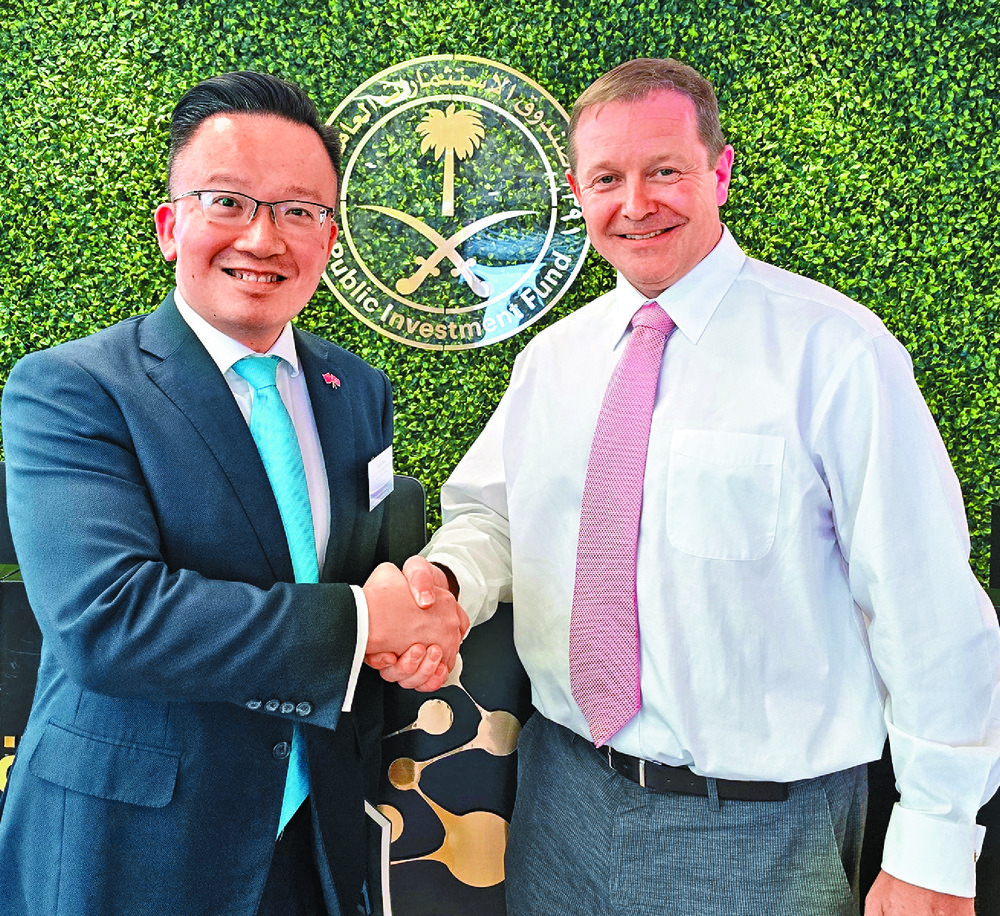
Nick Chan with a representative of Saudi Arabia's Public Investment Fund, one of the world's largest sovereign wealth funds with estimated total assets of at least US$620 billion.