Read More




Night Recap - June 9, 2026
8 hours ago

Bowie Wu, 94, sets Guinness World Record at star-studded concert
08-06-2026 18:03 HKT

Up to four cross-border trains carrying food and anti-Covid supplies from Shenzhen and three ferry routes shipping 3,000 containers to Hong Kong every day are under way, says Secretary for Transport and Housing Frank Chan Fan.
Some 100 tonnes of frozen pork - or 90 percent more than usual - and 2,500 tonnes of vegetables - 10 percent than usual - were delivered after stepped-up collaboration with the mainland, Chan said, adding he believes prices will return to normal shortly.
Speaking on radio yesterday, Chan said authorities are using all transportation on land, sea and rail to ensure a stable supply of produce from the mainland.
Authorities activated cross-border cargo trains from Shenzhen on Wednesday, with one pair of trains running per day and up to four pairs of trains running daily in the future.
"At sea, we will open three regular cargo ferry routes from Shenzhen, which can ship around 3,000 containers to Hong Kong every day," he said.
Chan said among 8,000 cross-border drivers in Hong Kong, one-fourth have been infected or observed quarantine as close contacts.
After discussion with Shenzhen authorities, the Man Kam To control point will be designated for transportation of fresh food, while the Lin Tong/Heung Yuen Wai port will be the back-up.
The Transport and Housing Bureau is also setting up temporary cargo transfer yards for nonfresh food items at the Hong Kong International Airport, Kwai Chung Container Terminals and Tuen Mun River Trade Terminal, where mainland cross-border drivers in "closed-loop management" will drive their trucks to hand them over to local drivers without any contact.
Chan sidestepped questions on whether the territory-wide mandatory test will come with a lockdown, but said authorities will guarantee normal food supply and look after people's needs when making policies.
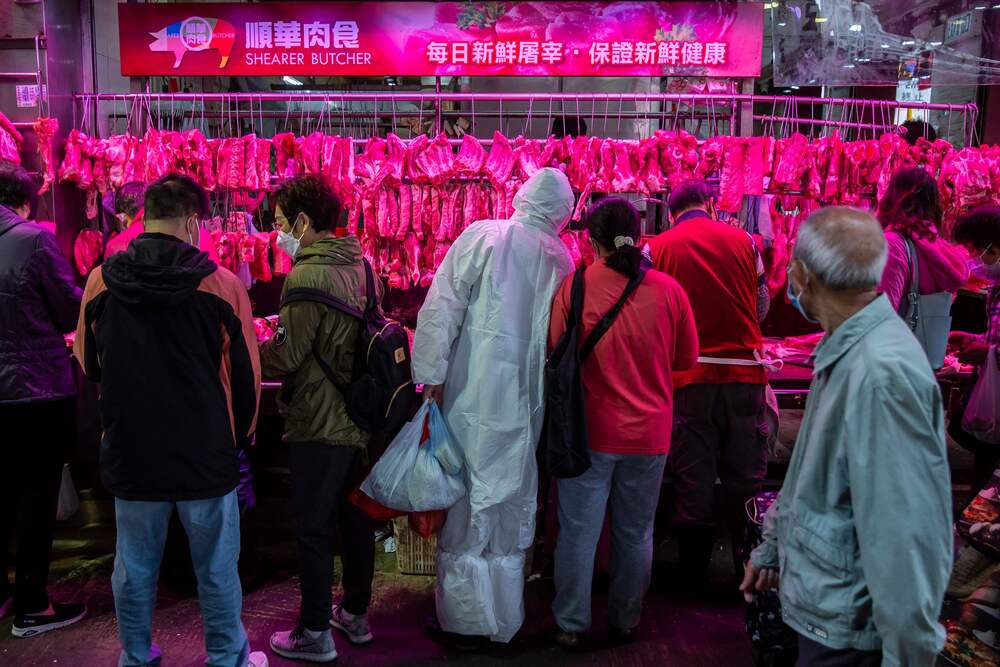
Meanwhile, Sheung Shui slaughterhouse could resume fresh meat supply on Wednesday with all workers to undergo testing on Sunday, said Pork Traders General Association chairman Hui Wai-kin.
The slaughterhouse closed on February 26 after 170 of 800 workers got infected. Hui said operations at a slaughterhouse are interlinked. When there is a manpower shortage in one section, the entire production line is disrupted.
Only around 20 percent of staff are not infected or under quarantine who can still work in the slaughterhouse, in addition to 38 mainland butchers who arrived on Wednesday.
Hui said before the outbreak, the Sheung Shui abattoir handles 3,000 pigs every day and 400 to 500 in the city's other slaughterhouse in Tsuen Wan. But with the Sheung Shui site suspending operation, the supply of fresh pork to the retail market has dropped 90 percent.
Hong Kong and Kowloon Provisions, Wine and Spirit Dealers' Association chairman Yip Pun-leung said the city has stocks of canned food sufficient for three months and so there is no need for panic buying.
More than 80 percent of canned food in Hong Kong came from Sichuan, Henan and Anhui provinces, he said.
Mainland factories have resumed work after the Lunar New Year holiday and the city is expected to see several millions more canned food arriving this month.
"But goods will continue to arrive in Hong Kong," he said. "Shelves were emptied because many in the logistics industry were infected and the transport capacity could not catch up with the supply. There is sufficient stock of grain, oil and rice in Hong Kong."
However, even with all the assurance that Hong Kong is not short of stuff, but staff, some supermarkets still saw empty shelves for the fourth day yesterday as people continued to scramble food and necessities.
jane.cheung@singtaonewscorp.com